Oct 2026 – now · FounderOct 2026 – now · Founder · Research tooling
Nala
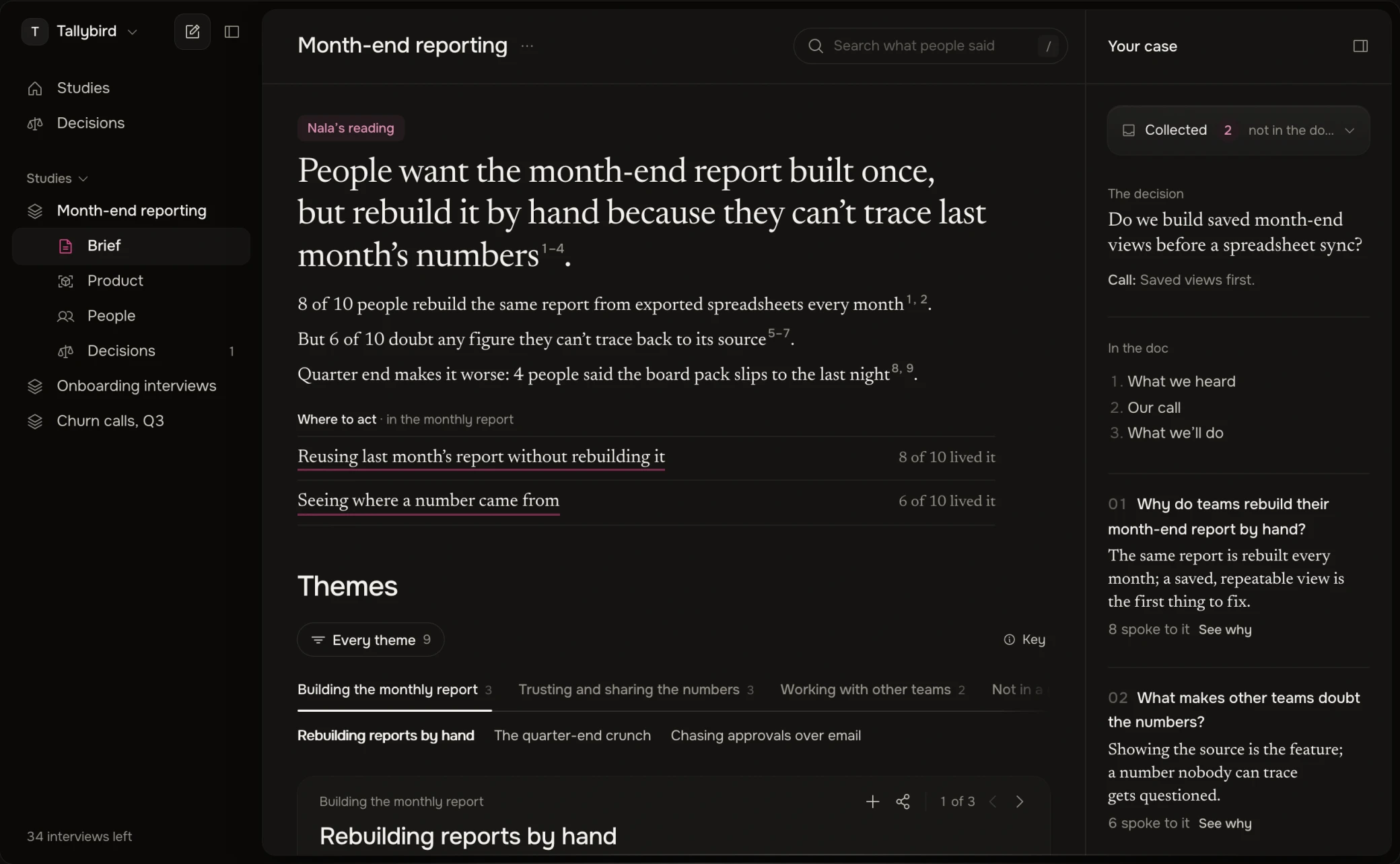
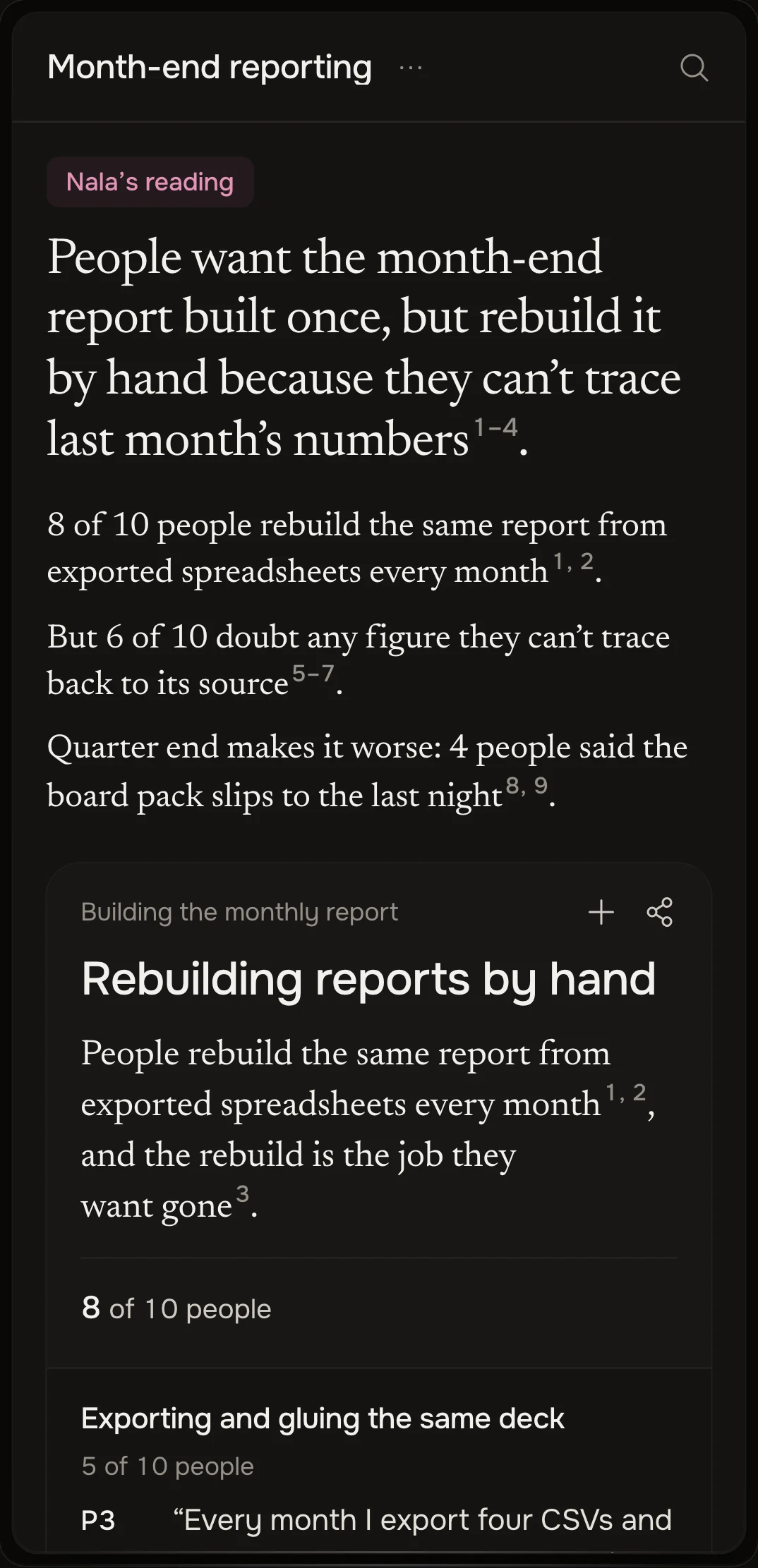
Customer-interview analysis for product teams. It reads every interview the same way, counts people rather than mentions, and ends in a case the team can check.
- Role
- Product, design and build
- Built
- Solo, with Claude Code · 3,600+ commits
- Under the hood
- Machine learning, NLP and language models
- Stage
- Live, paid plans ·
01
Why I built it
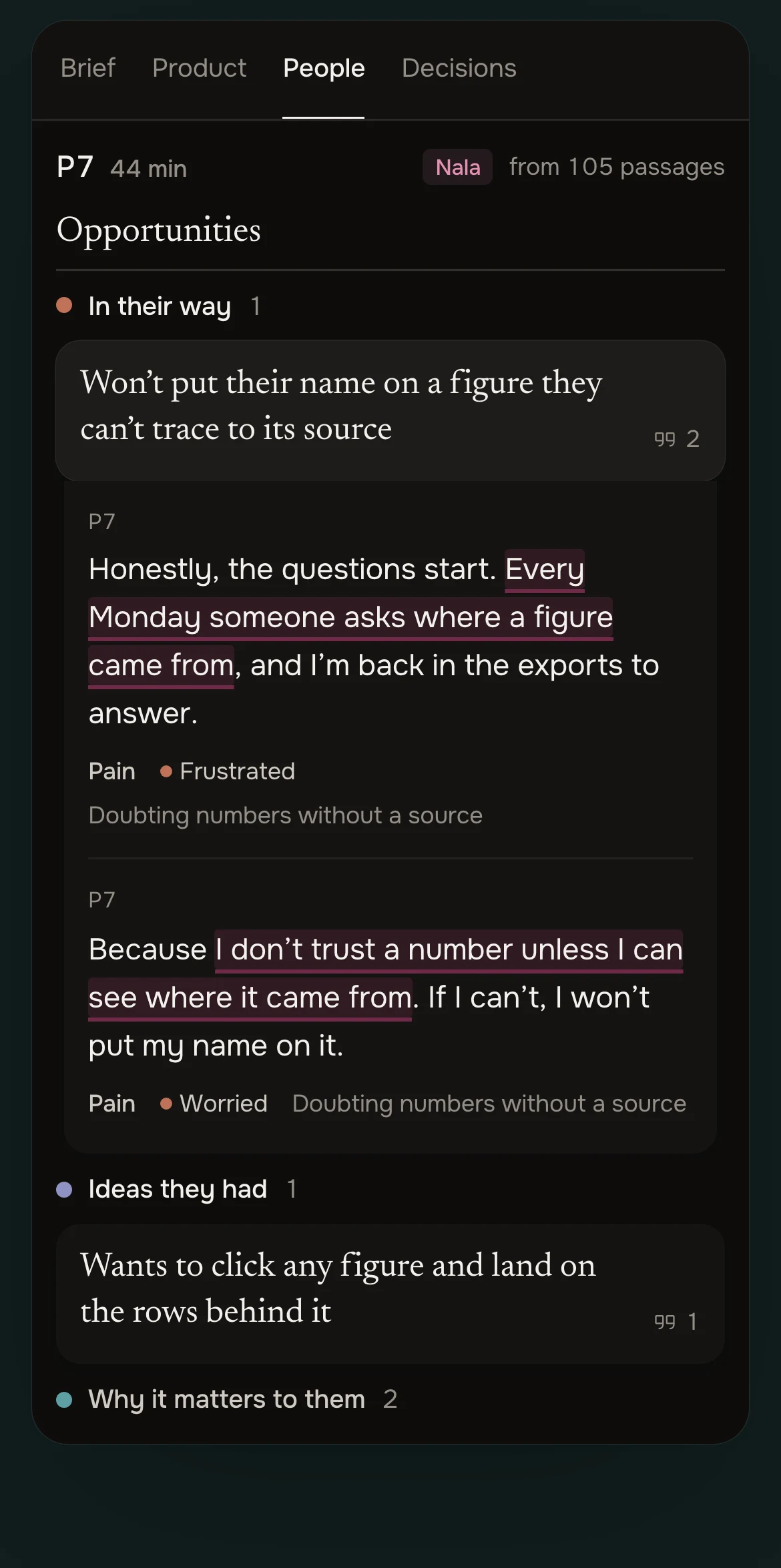
My job as a product manager is to know customers well enough to build the right things, and to say no to the rest. The second half is the harder half.
Ideas arrive from everywhere, and many have little to do with what customers have told us. Deciding together what not to build takes more than a hunch. It takes evidence everyone can open and check, and that evidence was always in the interviews.
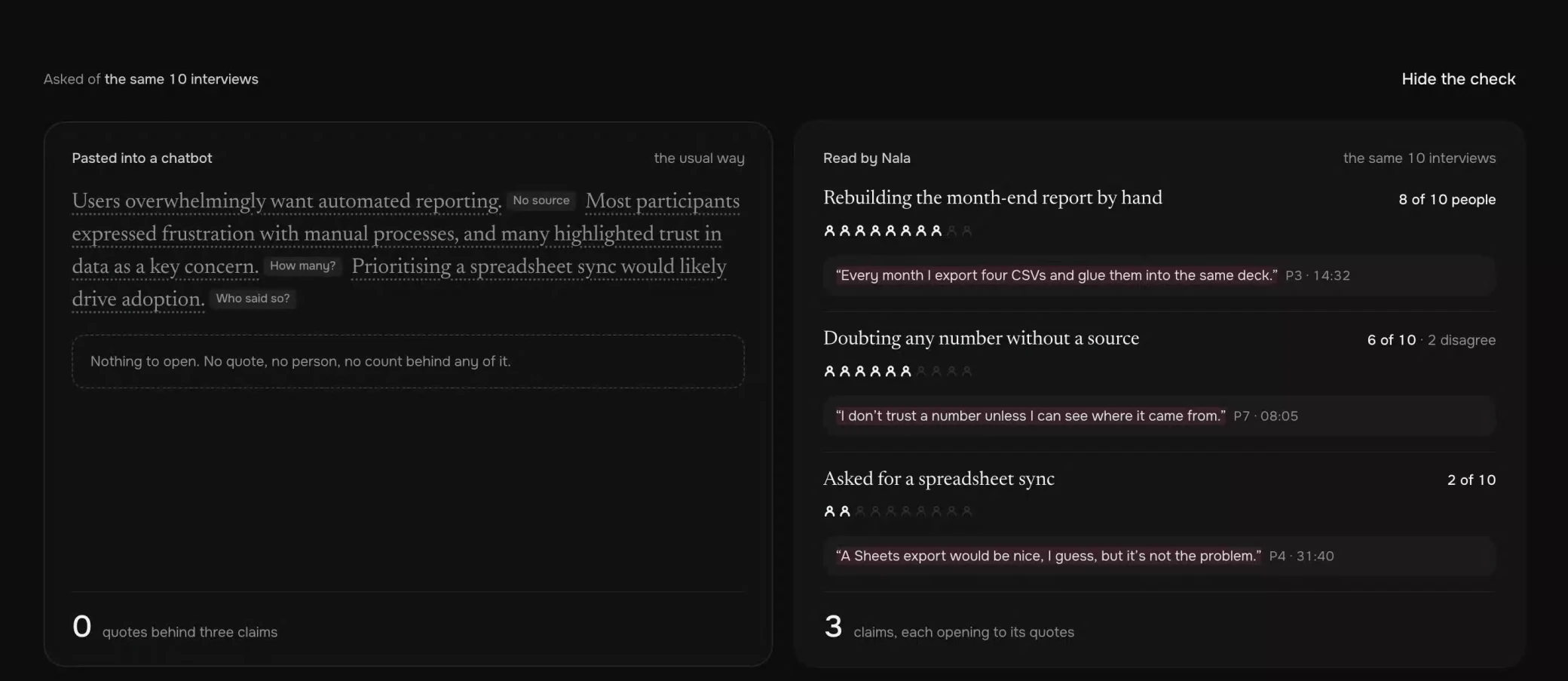
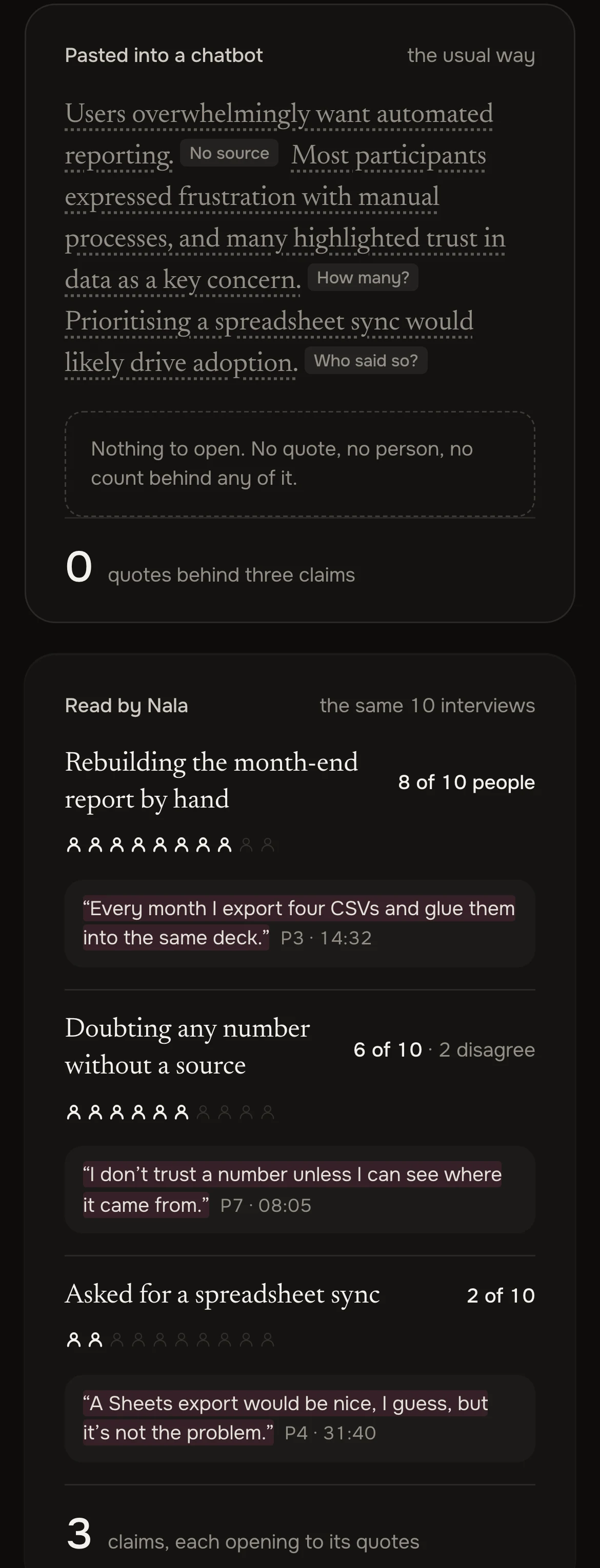
Ten hour-long interviews come to well over a hundred pages of transcript, and by the tenth I was skimming. So I pasted them into a chatbot, like most of us do. It gave me confident paragraphs. I couldn’t tell who had said any of it, or how many people had, and neither could anyone I showed it to.
02
The problem it solves
Even good findings lost their evidence on the way to the decision.
They went into a slide deck, where a quote became a bullet point, or a Notion page nobody opened twice. The meeting ran on whoever sounded surest, not on what customers said.
Teams already have a fast answer: paste the interviews into ChatGPT, build the deck in Gamma. It’s quick and it looks good, but nothing in it can be checked, and a sceptical engineer knows it. Research repositories like Dovetail solve a different problem: they’re built for research teams. A 20-person start-up doesn’t need an archive. It needs the team to agree on one decision this week.
What customers said
Interviews you already ranTranscripts, or calls from a recorder.Nala
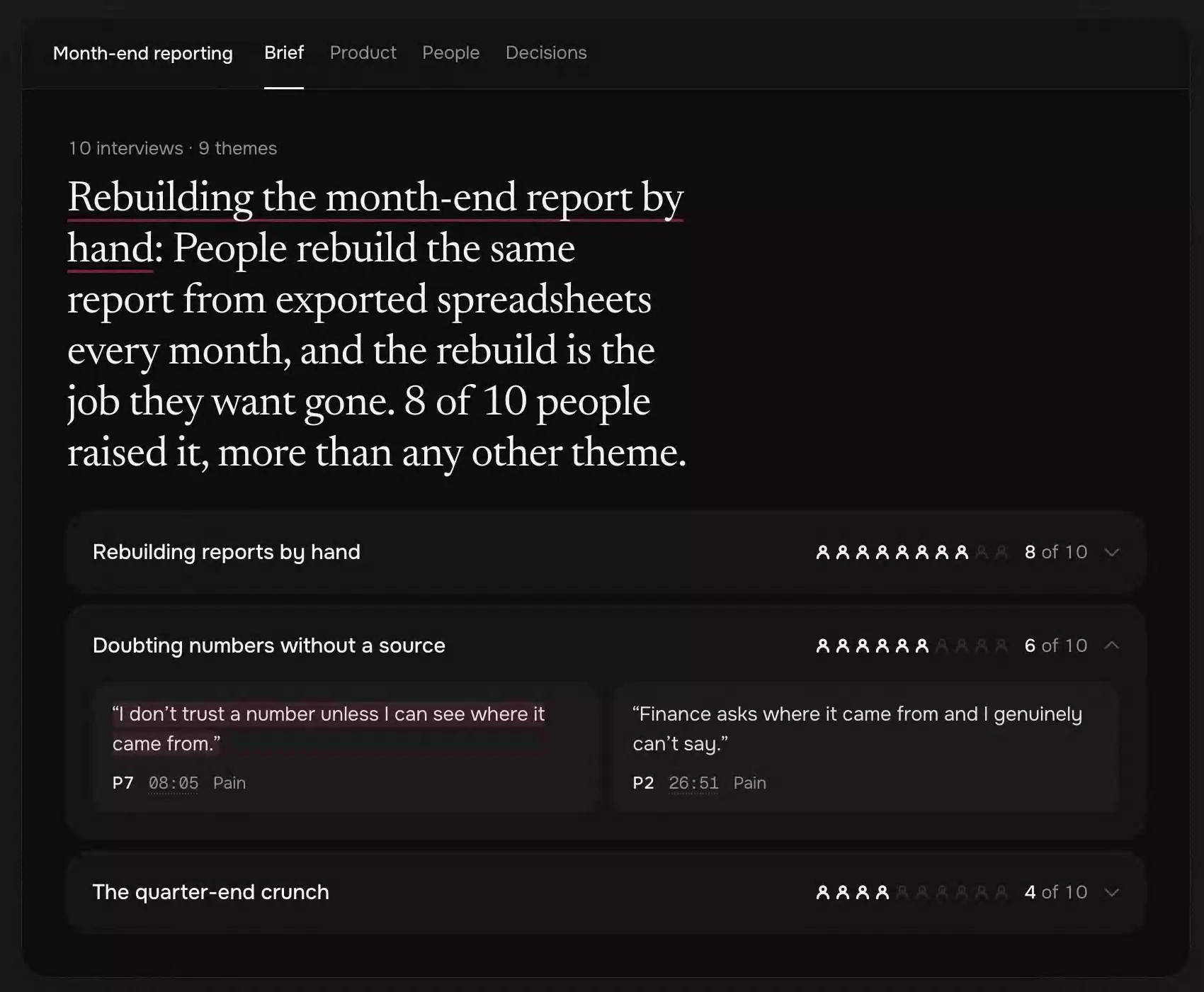
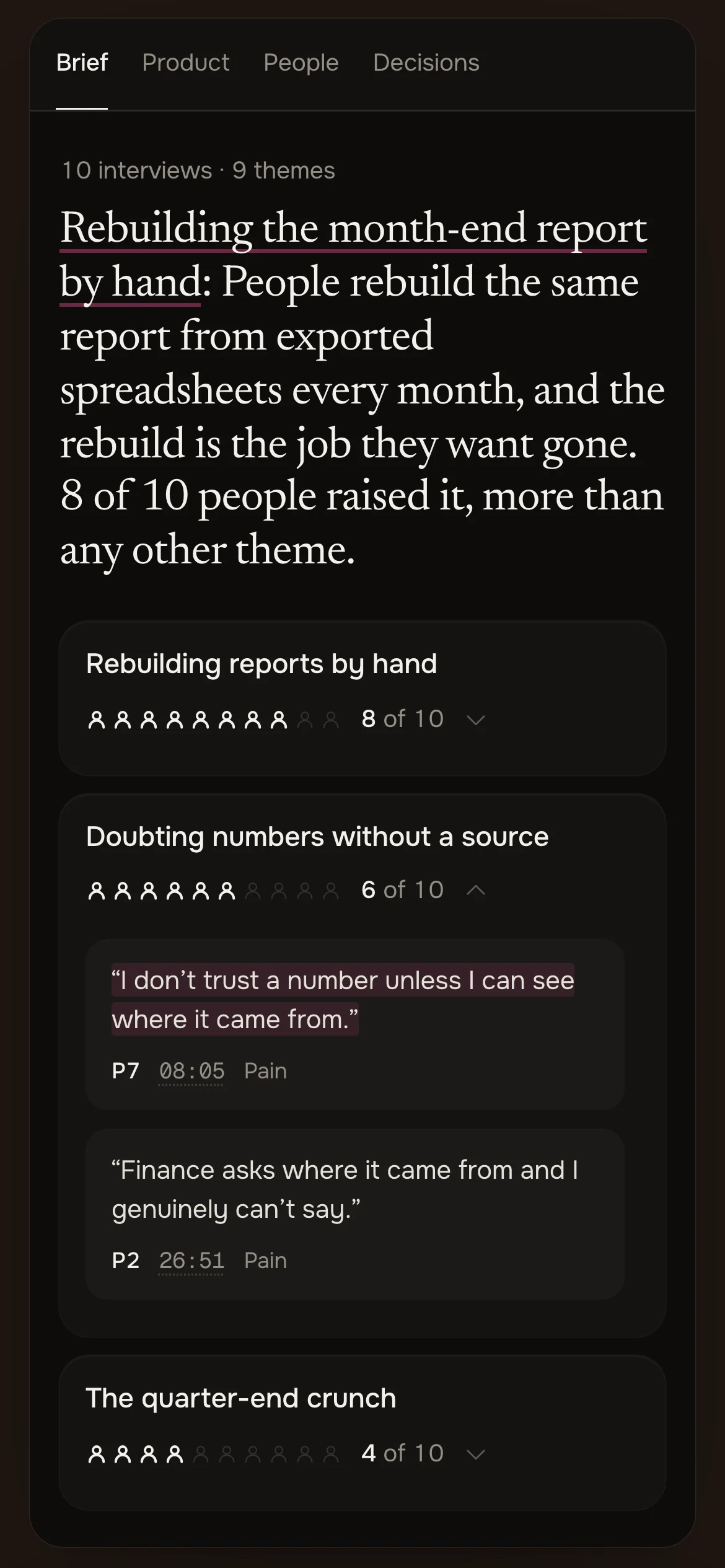
Counted evidenceThemes, people and quotes, counted.You, with Nala
A caseYour call, their words, and what cuts against it.The team
A decision, recordedWhere a research tool stops at themes, Nala stops here.
03
Who it’s for
Small product teams with customer words and a decision to agree on.
The sharpest case is the product manager at a company of 10 to 50 people. They’re expected to set direction, but they only get the authority to do it when they tie it to a goal the founders already own, and prove it well enough that engineers and founders act. I’ve been that PM.
The person they most need to bring along is usually a founder who isn’t from product, and who will give the case three minutes.
It isn’t for insights teams whose deliverable is the study itself, for brand tracking, or for monitoring tickets at scale. Nala reads interviews and nothing else.
04
How it reads an interview
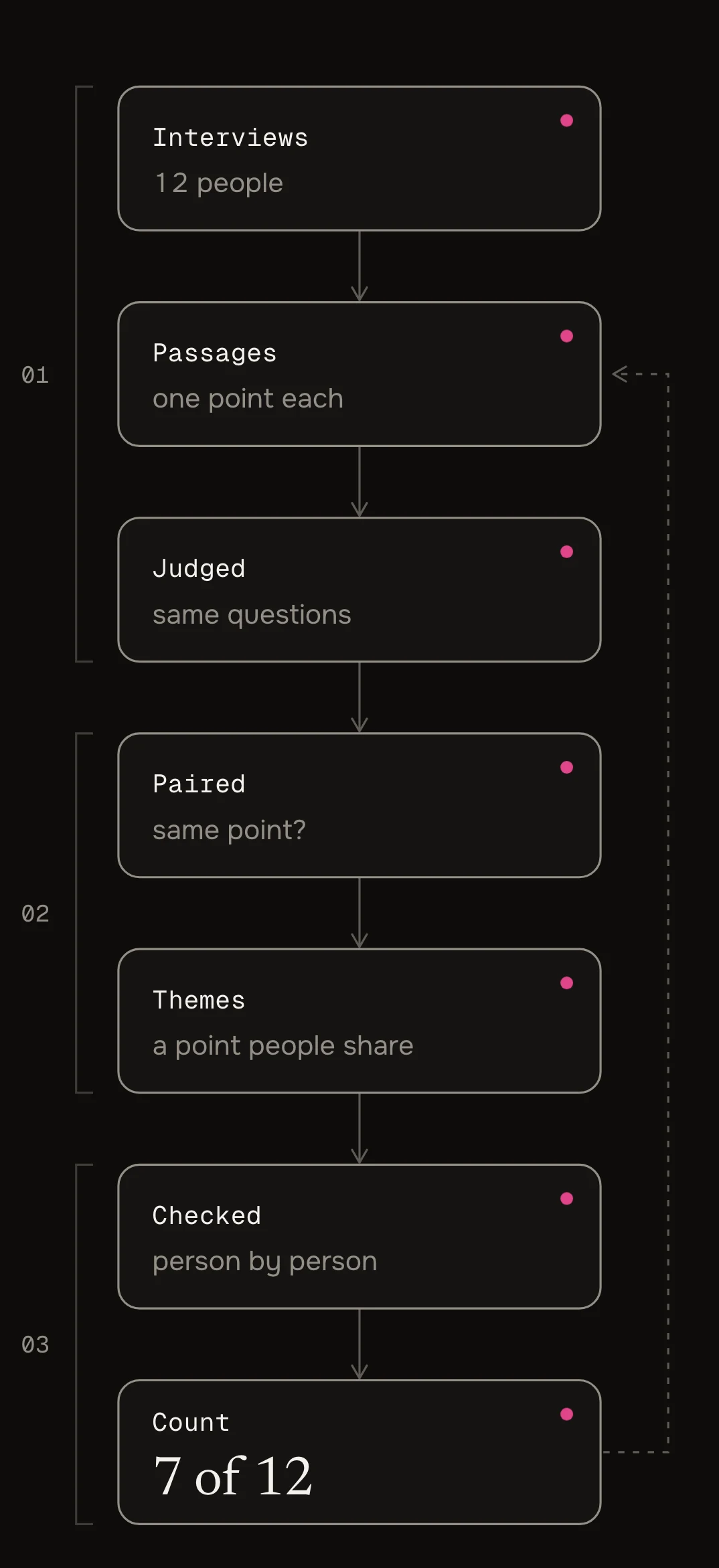
Models make small judgments a person could check. Code does the counting.
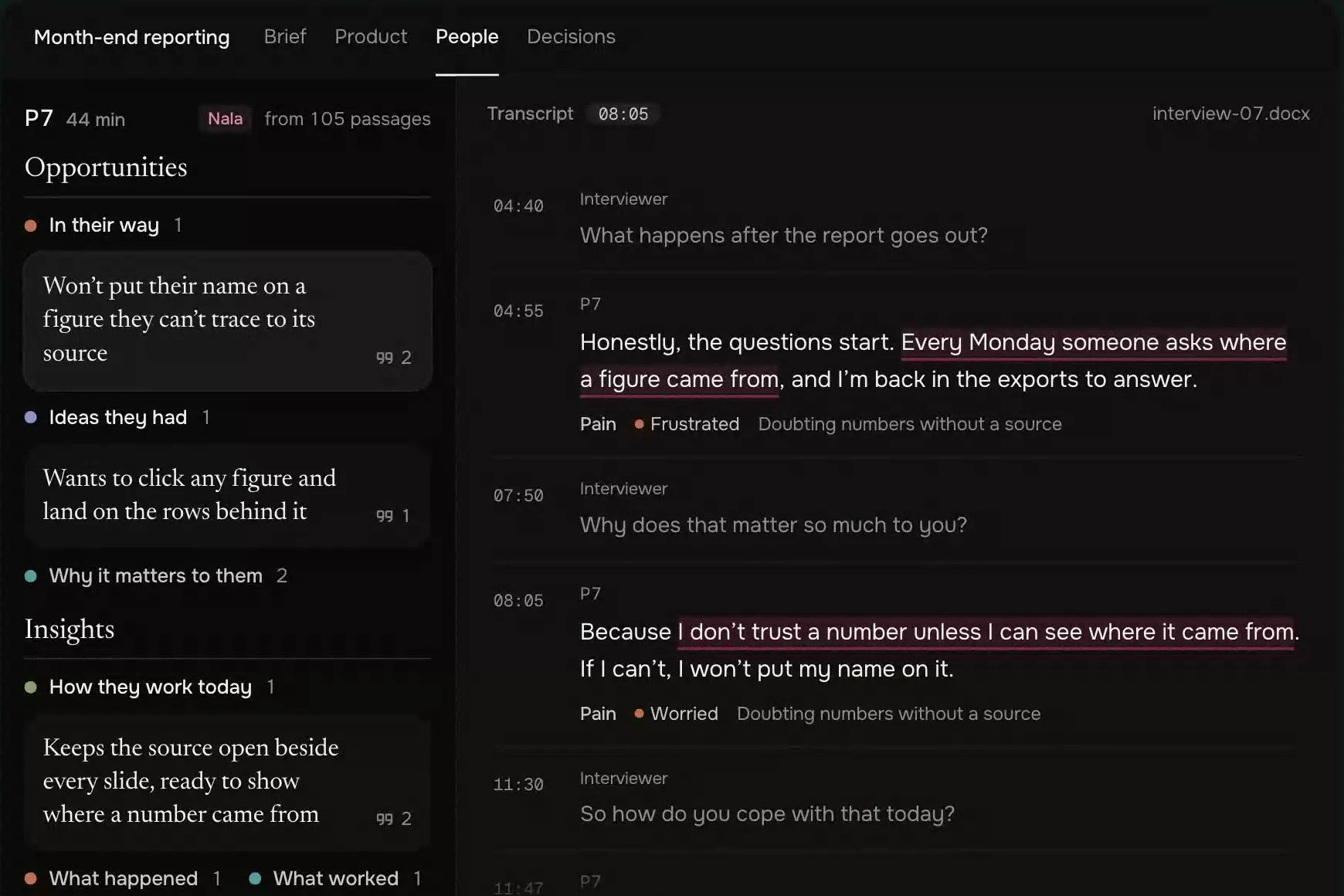
Nala follows the phases of thematic analysis (Braun and Clarke, 2006): code every passage, search for themes, then review each one against the transcripts. It never asks a model what the data says. It asks thousands of small, typed questions, stores every answer, and counts them in the database. A language model does one job, last: it names and summarises each theme, citing its quotes.
Classical ML and NLP · Jev, a model that answers fixed questions instead of writing · an LLM only to name and summarise
Stage 1
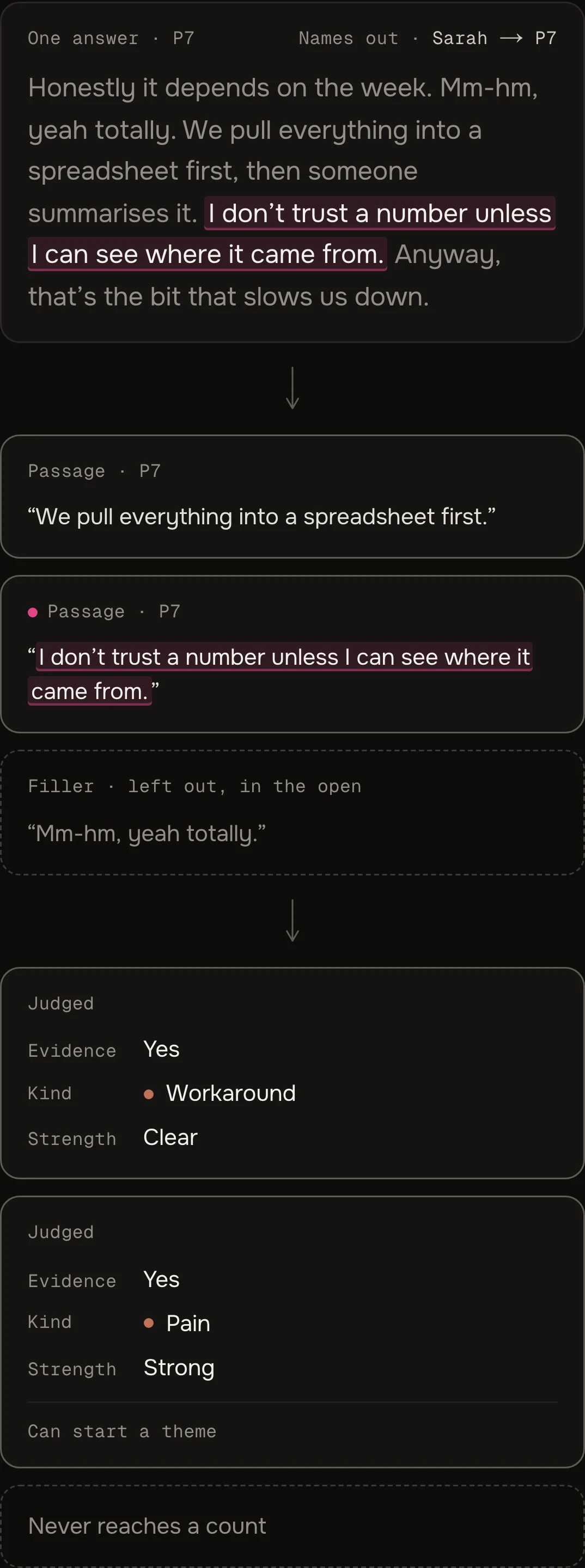
Only real evidence is counted
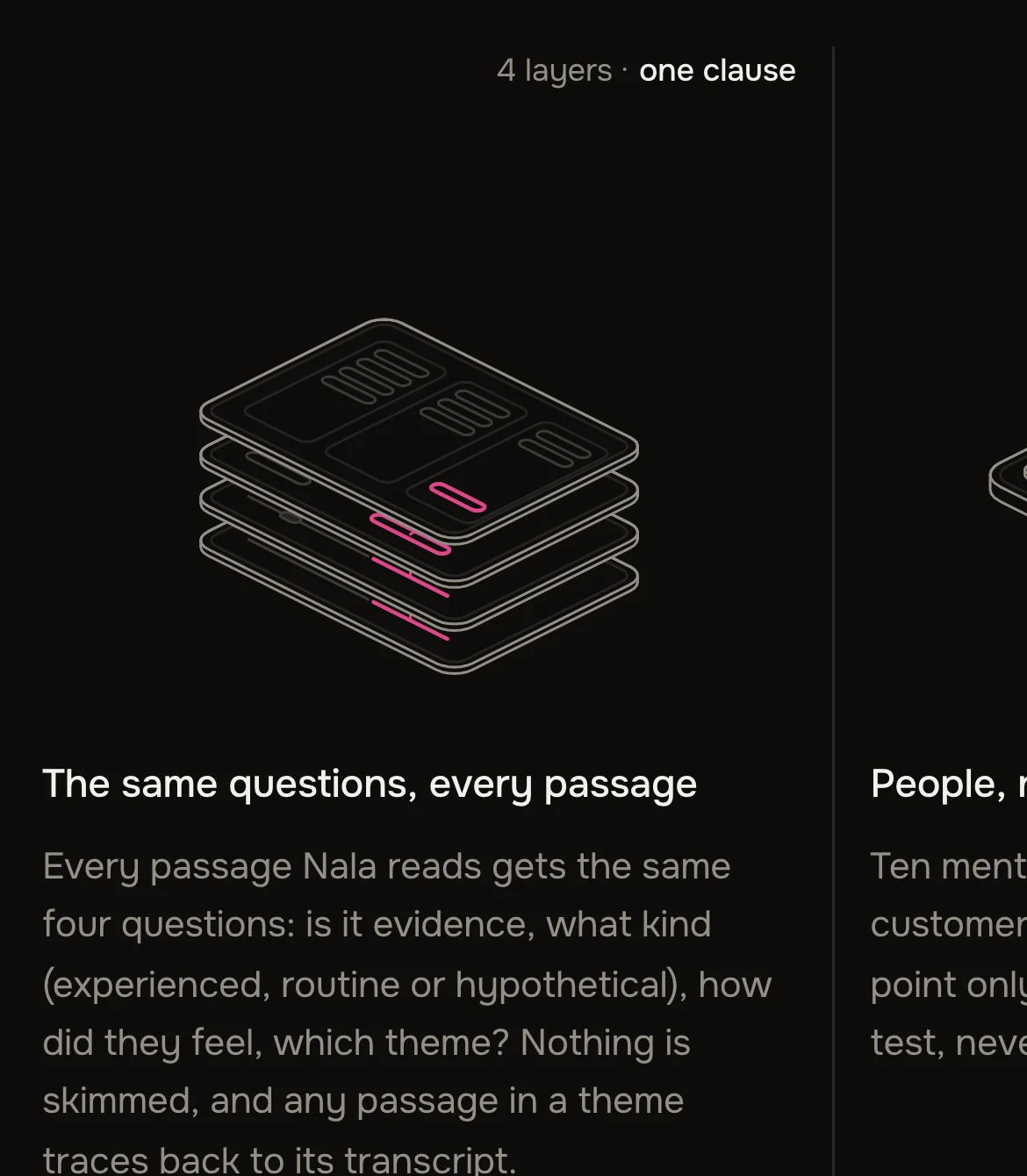
Every answer is split into passages that each make one point. People’s names are removed first. Each passage gets the same questions, answered by a model built to judge, not to write. Small talk never reaches a count.
Stage 2
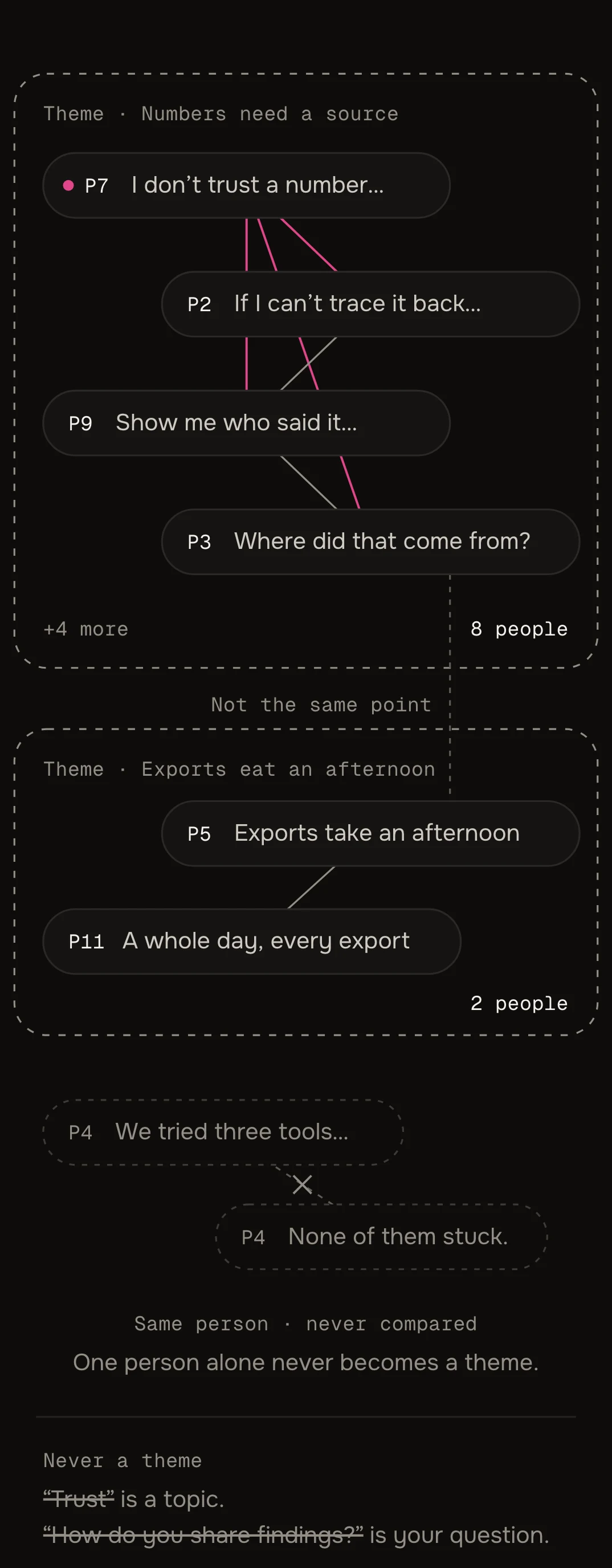
A theme needs more than one person
Two customers can use the same words for different problems. Nala asks, pair by pair, whether two passages make the same point. A theme reads as a sentence, never a topic like “Trust”.
Stage 3
Every count is checked, and stays put
Before anyone is counted, Nala checks they actually make the point. Every judgment is saved with the words it was made on, so the same interviews give the same count every time you run them.
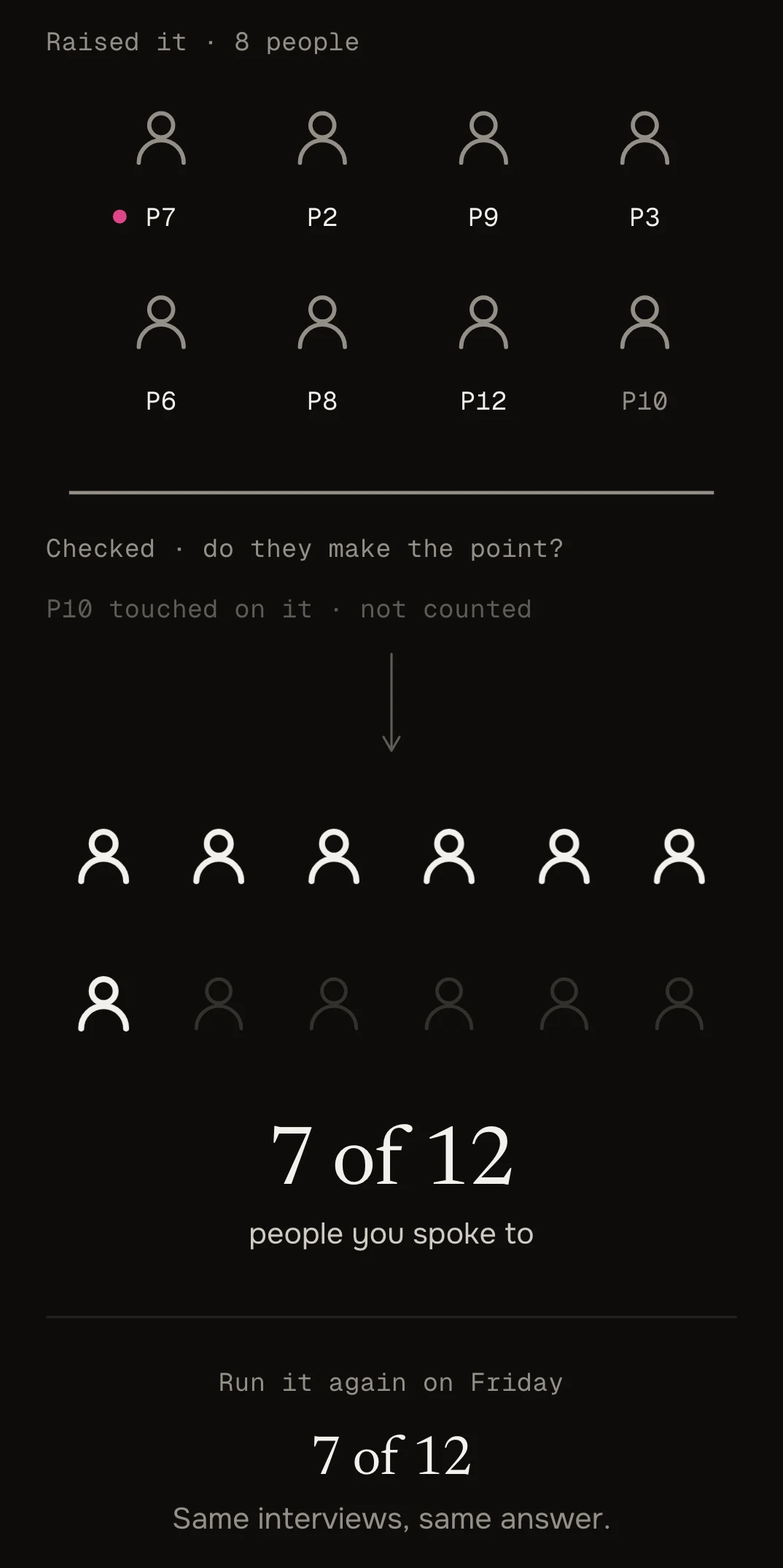
Of known themes found in a typical first run
I don’t claim Nala finds everything. Two test sets with known themes planted were each analysed ten times from scratch, as clean text and as automatic transcripts. What I claim is that the miss is measured, and published.
05
The case editor
The analysis is how you get there. The case is the product.
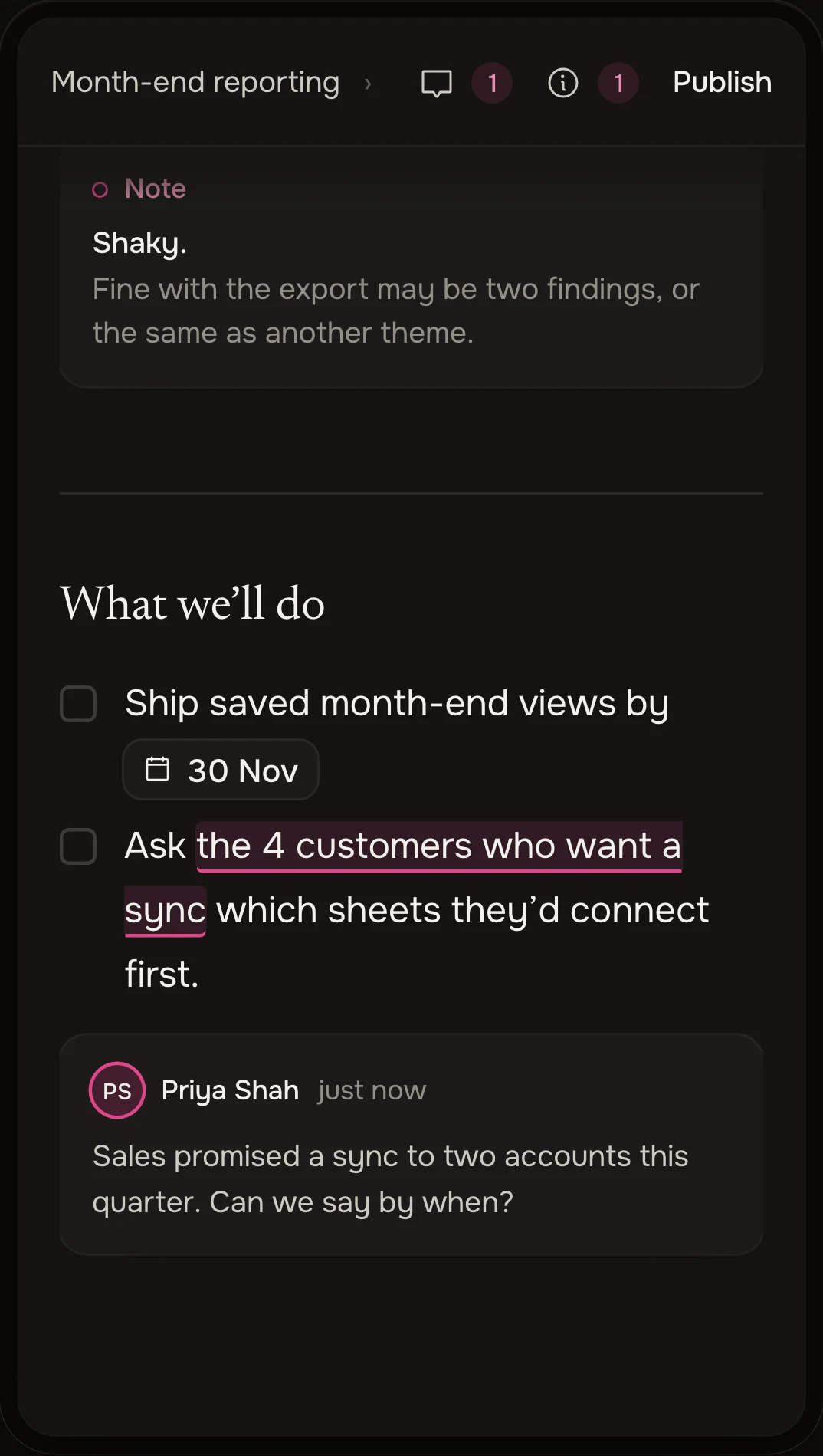
A case is a short doc in three parts: what we heard, what we decided, and what we’ll do. It writes like any doc. Type # for a theme or @ for a person and they arrive with their counts. The call is always the author’s, with their name on it.
Nala checks it as you write: a line with no source, a shaky theme, a claim that says more than the interviews do. Then it goes where decisions really get made: a read-only link, a presentation or a PDF. The team comments until it agrees, and the outcome is recorded.

06
Calls I made
Most of the product is what I chose to leave out.
Nala counts. Models don’t.
Clustering and small, typed judgments decide what a theme is and who said it. A language model may only put a finding into words, citing its quotes.
Ruled out: chat with your data, AI summaries
Interviews only.
Nala used to read reviews, tickets and surveys too. I cut them: one kind of evidence, read deeply, keeps Nala simple.
Ruled out: another full research suite
The case is a doc the author writes.
Cases used to open pre-filled from the analysis. Now they start as a short template, and Nala’s words enter only as suggestions kept line by line.
Ruled out: a deck generator
Decisions, not topics.
Other tools show topics and what people said. Nala is built around the decision: done means a decision recorded with what happens next, not themes viewed.
Ruled out: a research repository
07
Where it doesn’t hold
A tool about evidence should show its own limits.
- It reads interviews and nothing else.Reviews, tickets and surveys are left out on purpose.
- It doesn’t make the decision.The call in a case is always the author’s, with their name on it.
- A count says who raised a point, not how common it is.Ten interviews are ten people, not a market.
- A model writes the theme names and summaries.It does that last, from each theme’s own quotes, and never decides what counts.
Next · Co-founderNext · Mar 2026 – now · Co-founder
OpenStableA three-sided equestrian marketplace for UK livery and services.Case studyTalk about Nala
Get in touch
I’m happy to walk you through Nala live, and the calls behind it.